
Home › Guides › How solar panels work, and why they work here
SolarHow solar panels work, and why they work here
Solar panels run on daylight, not sunshine. Britain has plenty of daylight. Here is what actually happens between the light landing on your roof and the number on your meter.
Updated 4 August 2026 · from the OVO Solar & Battery team
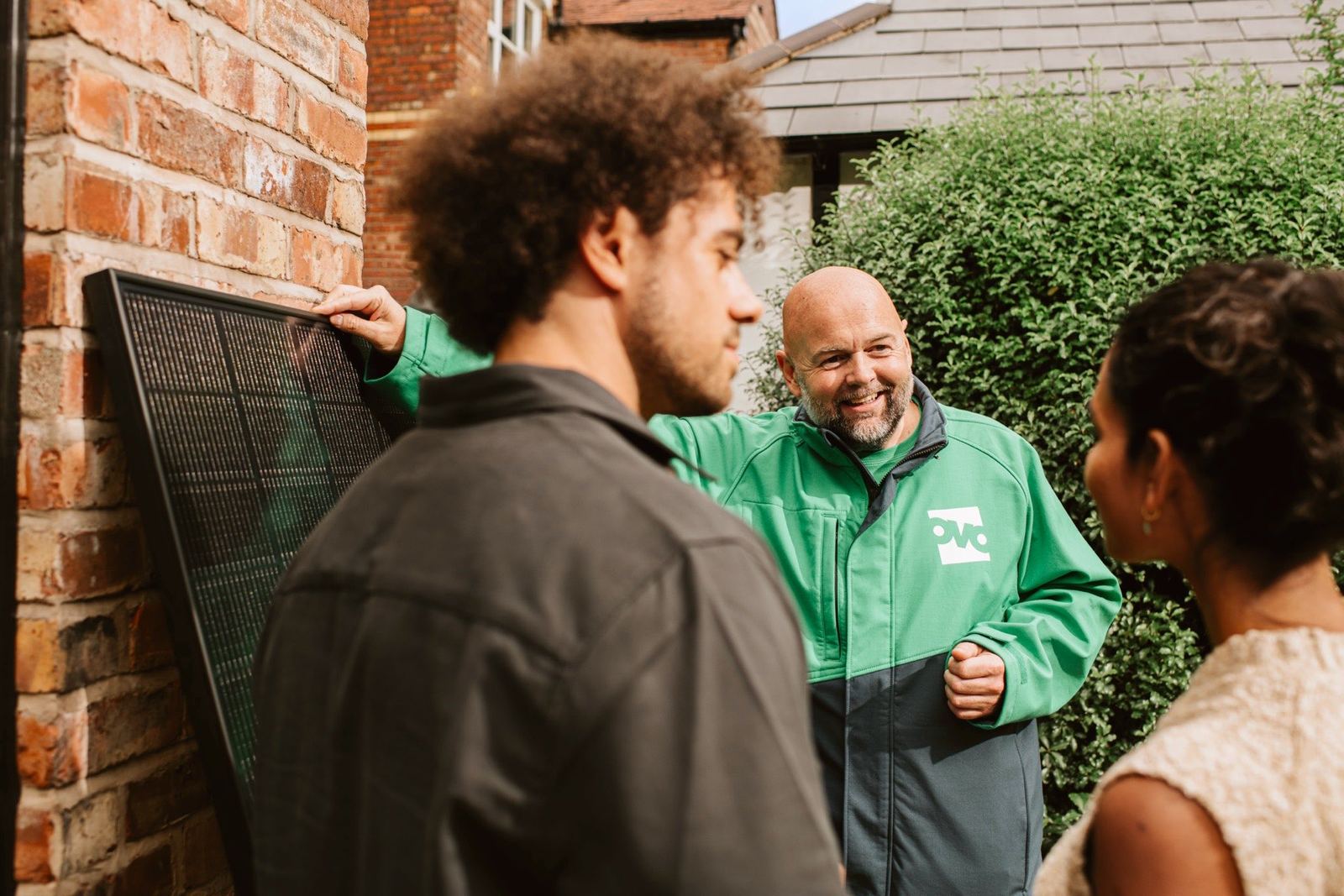
Light in, electricity out
A solar panel is a sheet of semiconducting material, almost always silicon, arranged in layers. When light lands on it, the energy knocks electrons loose and they flow in one direction. That flow is direct current, and the effect has a name: photovoltaic. Nothing spins, nothing burns, nothing gets used up.
Direct current is no use to your kettle, so an inverter converts it into alternating current at the voltage and frequency your house and the grid run on. After that it behaves like any other electricity in your consumer unit.
Daylight, not heat
Panels generate in proportion to light intensity. That is why they still produce on an overcast January afternoon, just less than on a clear June morning, and why a hot country is not automatically a better one for solar.
What a British roof actually produces
The UK average is about 998 kWh per kWp installed per year, which is roughly 2.7 peak sun hours a day. A 6.3 kWp system, which is 14 panels on a typical semi, generates around 6,289 kWh a year. Most households use nothing like that much.
| Region | kWh per kWp a year | Peak sun hours a day | 14 panels (6.3 kWp) generates |
|---|---|---|---|
| Devon and Cornwall | 1,060 | 2.90 | 6,678 kWh |
| South Coast and Wessex | 1,040 | 2.85 | 6,552 kWh |
| London and the Thames Valley | 1,000 | 2.74 | 6,300 kWh |
| Yorkshire | 910 | 2.49 | 5,733 kWh |
| North East and Cumbria | 880 | 2.41 | 5,544 kWh |
| North East Scotland | 850 | 2.33 | 5,355 kWh |
Figures assume a south facing roof at optimal pitch with no significant shading. Your free design accounts for your actual orientation, pitch and shading.
Even the lowest figure on that list produces more electricity than a typical home gets through in a year. Where you live changes how fast the system pays back, not whether it works at all. The coverage page shows the generation figure for your postcode area and the local OVO expert who looks after it.
Want your own numbers, on your own roof? A free 45 minute remote design gives you the layout, the generation forecast and a written price, with no home visit.
Get your free quote →Where the electricity goes, in order
- Your house takes what it needs first. Every unit you use on site is a unit you have not bought at the 26.11p cap rate.
- Anything left over charges the battery, if you have one fitted.
- After that, the surplus flows out to the grid and you get paid for it.
- When the sun is down and the battery is empty, you import as normal, ideally on a cheap overnight rate.
That order matters more than people expect. Without storage, a lot of a sunny day happens while the house is empty. A battery is what lets you keep the middle of the day for the evening, which is covered properly in our solar and battery strategy guide.
Want these numbers for your own roof rather than a national average? The free 45 minute video design does exactly that, with nobody visiting your home.
Get your free quote →Why a cold, bright day is a good day
Cells lose a little output as they warm up. Datasheets call this the temperature coefficient, and current N-type modules typically sit at around 0.24% to 0.29% of output lost per degree C above the 25C test condition. In practice a crisp bright spring day can out-produce a hazy humid one in July, which surprises almost everyone.
What actually decides your number
- Roof orientation. South is best, but east and west split arrays spread generation across the morning and evening instead of peaking at noon.
- Pitch and shading. Shading costs more output than orientation does, and it is the thing we look hardest at on aerial imagery.
- Usable roof space. Most semi-detached roofs take 10 to 16 panels on one pitch.
- How you use electricity. A house that is empty all day gets far more out of a battery than one that is not.
- Your export rate, because everything you do not use is either income or waste depending on the tariff.
Those five inputs are the whole design. We work through them on the call using satellite and aerial imagery of your roof plus your meter data, and you see the layout on screen as we go. If you want the pricing side first, the solar panel cost guide has the full matrix.
OVO SEG Install Exclusive pays 20p per kWh where OVO installs both solar and battery, or 15p per kWh for solar only. The exclusive rates require you to take your electricity supply from OVO and are subject to system size limits. OVO's standard SEG rate of 4p per kWh is open to customers of any supplier. Rates correct at July 2026 and subject to change.
How it works, answered
Do solar panels need direct sunshine to work?
No. Panels generate in proportion to how much light reaches them, so an overcast day produces less than a clear one but still produces. That is why the UK average of about 998 kWh per kWp a year holds up across the whole country rather than only in the south west.
What does kWp actually mean?
Kilowatt peak. It is the rated output of the array under standard test conditions, so it describes the size of the system rather than what it will make in a given hour. Multiply kWp by your regional kWh per kWp figure and you get the annual generation estimate.
How much electricity does a 6.3 kWp system generate?
Around 6,289 kWh a year at the UK average of 998 kWh per kWp, and more in the south west. That is 14 panels, which is what a lot of semi-detached roofs take on a single pitch.
Does heat make panels work better?
The opposite, slightly. Output falls as cell temperature rises above the 25C test condition, at roughly 0.24% to 0.29% per degree on current N-type modules. Light intensity is what drives generation, not warmth.
Where do I find the figure for my own area?
The coverage page carries the regional generation number for each postcode area, along with the named OVO expert who covers it. Your free design call then replaces the regional average with a figure built from your actual roof.
Figures and specifications in this guide are sourced below and were checked on the date shown. Rates and product specifications change; we confirm the current picture on your free design call.
Sources
- How photovoltaic cells convert light into direct current, and the role of the inverter energysage.com
- Generation in proportion to light intensity, including cloud and winter output sunsave.energy
- Module temperature coefficients on current N-type products (REC Alpha Pure-RX, Longi Hi-MO X10, Jinko Tiger Neo datasheets) recgroup.com, jinkosolar.com
- Regional generation figures, system sizes and pricing as published on this site ovosolarandbattery.co.uk
- Ofgem energy price cap, 1 July to 30 September 2026 ofgem.gov.uk
Read next
Cloudy days and north facing roofs, answered honestly
Cloud reduces output, it does not switch it off. North facing depends on pitch more than compass.
Read the guide →G98 and G99 explained: which one applies to your system
Two forms, one threshold, and your installer files both. What G98 and G99 actually mean.
Read the guide →Adding a battery to solar you already have
Your panels stay untouched. The grid application is the part that catches people out.
Read the guide →