
Home › Guides › Cloudy days and north facing roofs, answered honestly
SolarCloudy days and north facing roofs, answered honestly
Cloud reduces what a panel makes, it does not switch it off. North facing is the harder conversation, and the answer depends on the pitch angle more than the compass direction. Both, straight.
Updated 4 August 2026 · from the OVO Solar & Battery team
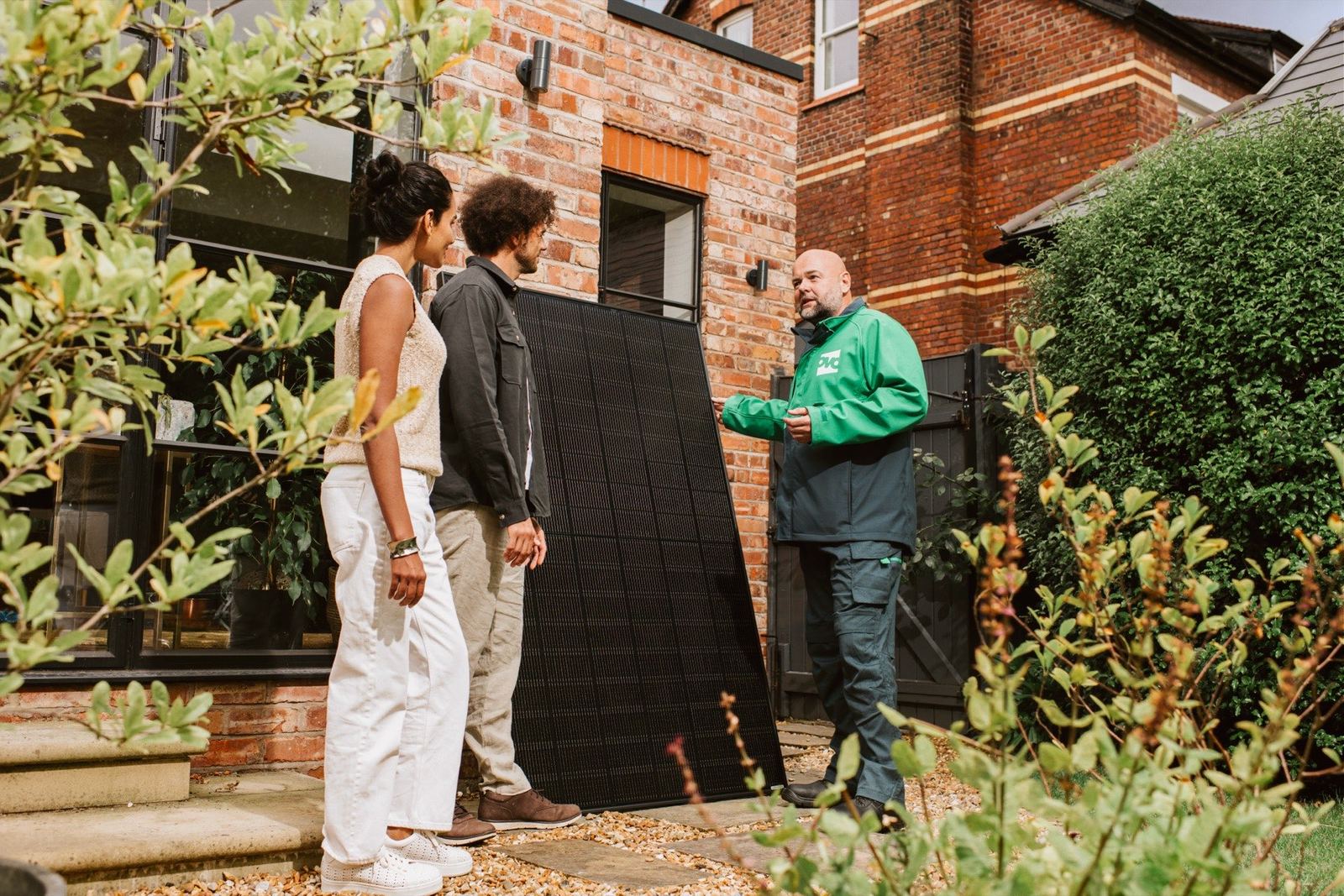
Cloud reduces output, it does not stop it
A solar panel converts light, not heat. The cells produce direct current in proportion to how much light reaches the glass, so output tracks brightness through the day rather than temperature. Cloud scatters light instead of blocking all of it, which is why an array keeps working through an overcast morning at a lower level rather than switching off.
The inverter plays a part too. UK systems are normally built with more panel capacity than the inverter is rated for, which is standard practice at a ratio of roughly 1.10 to 1.30. One side effect helps on dull days: a smaller inverter starts generating earlier in low light, so the array is doing something for more of the day instead of waiting for the sun to burn through.
Cold and bright beats warm and hazy
Cells lose output as they warm up. Current N-type modules give up roughly 0.24% to 0.29% of output for every degree C above the 25C test condition, so a crisp bright March day can out produce a humid July one. Light drives generation, not warmth.
What a British year actually adds up to
The UK average is about 998 kWh per kWp installed per year, which works out at roughly 2.7 peak sun hours a day. A 6.3 kWp system, which is 14 panels on a typical semi, generates around 6,289 kWh a year on that average. Most households use nothing like that much electricity.
That average already includes the bad days
998 kWh per kWp is not a fair weather number. It is what a system produces across a full British year, with the cloud, the rain and the short December afternoons already in it. Nothing in that figure assumes a Mediterranean summer.
| Where the unit goes | What it is worth | The conditions |
|---|---|---|
| Used in your home | 26.11p | The capped average electricity unit rate for 1 July to 30 September 2026 |
| Exported, OVO fitted solar and battery | 20p | OVO installs both, you take your electricity supply from OVO, system under 30kW |
| Exported, OVO fitted solar only | 15p | Same supply condition, no battery in the design |
| Exported, standard OVO SEG rate | 4p | Open to customers of any supplier |
Rates correct at July 2026 and subject to change. On a dull day almost everything you generate goes straight into the house, so it is the 26.11p line that applies rather than the export line.
North facing roofs, the honest version
A true north pitch is the one roof we will regularly tell you not to cover. It faces away from the sun for most of the day, and through the winter months it gets no direct sun at all. We do not publish a single percentage for it, because the answer moves too much with the pitch angle and the shading to be useful as a headline number. What we will do is model your actual roof and show you the figure on screen.
Pitch matters more than the compass
- How steep the pitch is. The flatter the roof, the less the compass direction costs you, because the panel sees more of the sky. A steep north pitch is the worst case, a shallow one is far closer to a flat roof.
- Whether the pitch is genuinely north. Plenty of roofs described as north facing are really north east or north west, and that changes the answer materially.
- Whether there is an east or west pitch to use instead. Splitting an array across two aspects spreads generation into the morning and the evening rather than stacking it at noon, and it usually beats forcing panels onto the wrong face.
- Shading from chimneys, dormers, trees and the house next door, which we look at on aerial imagery before anything else.
- How you actually use electricity. A house that is empty until six gets more out of a battery than out of an extra pitch.
Book the free 45 minute video design and your local OVO expert will model your real pitches, shading and usage, with a written quote on the call and nobody visiting your home.
Get your free quote →Shade is the bigger issue, and it is fixable
Orientation gets the attention, shade does the damage. On a plain string setup every panel is wired in series into one inverter, and the string performs at the level of its weakest panel, so one module in the shadow of a chimney can drag the whole row. There are three standard answers to that, and the right one depends on the roof rather than on what a salesperson prefers to fit.
| Setup | What it does | When it earns its place |
|---|---|---|
| One string inverter | Every panel wired in series to a single central inverter. Cheapest and simplest, but the string runs at the level of its weakest panel. | A single unshaded pitch on one orientation |
| Power optimisers | A small unit on each panel conditions its output before it reaches the inverter, and gives panel level monitoring. Some types can be fitted to only the affected panels rather than all of them. | Partial shade from a chimney, dormer or tree, or a split array |
| Microinverters | A small inverter on every panel, converting at the module. Each panel runs independently, so one shaded module does not drag the rest. | Complex roofs, several orientations, or persistent shading |
Modern back contact panels also bypass individual shaded cells inside the module, which reduces how often extra hardware is needed at all. Your design call covers which of the three your roof genuinely requires.
Want your own numbers, on your own roof? A free 45 minute remote design gives you the layout, the generation forecast and a written price, with no home visit.
Get your free quote →How we work out your roof rather than an average
- You book the free 45 minute video design. Nobody comes to the house.
- We open your roof on satellite and aerial imagery with you on screen and go through it pitch by pitch, marking the shading.
- We take your annual kWh from a bill rather than an estimate, and size the system to how you actually use electricity.
- You get a written quote on the call, built on the generation figure for your roof instead of a national average.
- If a pitch is not worth covering, we say so on the call. That is a far better conversation than the one after the scaffold comes down.
Pricing for each system size is in our solar panel cost guide, the sequencing of panels and storage is in the solar and battery strategy, and the export conditions are set out in the export rate guide. To see who looks after your area, use the coverage page, and anything else is in the help centre.
Sixteen installer businesses were selected from around 200 assessed to become Powered by OVO, and every job carries the OVO guaranteed 10 year workmanship warranty, so book the free design and find out what your roof will really do.
Get your free quote →OVO SEG Install Exclusive pays 20p per kWh where OVO installs both solar and battery, or 15p per kWh for solar only. The exclusive rates require you to take your electricity supply from OVO and are subject to system size limits. OVO's standard SEG rate of 4p per kWh is open to customers of any supplier. Rates correct at July 2026 and subject to change.
Cloud, shade and orientation, answered
Do solar panels work on cloudy days?
Yes, at reduced output. Panels generate in proportion to the light reaching them, and cloud scatters light rather than blocking it entirely, so an overcast day produces less than a clear one but still produces. The UK average of about 998 kWh per kWp a year is measured across a full British year, cloudy days included, so the cloud is already priced into the number.
Do solar panels work in winter?
They generate every month of the year, with far less in the winter half than the summer half because there is less daylight to work with. Cold itself is not the problem. Cells actually perform slightly better at low temperatures, losing roughly 0.24% to 0.29% of output per degree C above the 25C test condition, so a bright cold day is a good day.
Are north facing solar panels worth it?
Usually not on their own. A true north pitch faces away from the sun for most of the day and gets no direct sun through the winter months. Two things rescue a lot of houses described as north facing: the pitch is often really north east or north west, and most homes have an east or west face that works well. We will tell you straight on the design call if a pitch is not worth covering.
Is an east or west facing roof any good?
Yes. South is the strongest single aspect, but an east and west split spreads generation across the morning and the evening instead of concentrating it around midday. That often suits a household better, because it lines up more of the generation with the hours people are actually at home using electricity.
Does shade from a tree or chimney ruin a system?
It does not have to. On a plain string setup the whole string runs at the level of its weakest panel, which is why shading needs designing around. Power optimisers can be fitted, in some cases only to the affected panels, and microinverters let every panel run independently. Modern back contact panels also bypass shaded cells inside the module.
Does a dull day mean the electricity is worth less?
The opposite, in practice. On a low output day almost everything you generate is consumed in the house, and a unit used at home offsets the 26.11p capped rate rather than earning an export rate. Cloudy day generation is small but it is the most valuable kind, unit for unit.
Figures and specifications in this guide are sourced below and were checked on the date shown. Rates and product specifications change; we confirm the current picture on your free design call.
Sources
- Generation in proportion to light intensity, including output through cloud and winter sunsave.energy
- Photovoltaic conversion of light into direct current and the role of the inverter energysage.com
- Module temperature coefficients on current N-type products (REC Alpha Pure-RX, Longi Hi-MO X10, Jinko Tiger Neo datasheets) recgroup.com, jinkosolar.com
- Series string behaviour, power optimisers and microinverters compared energysage.com, solarreviews.com
- Selective optimiser deployment on only the affected panels tigoenergy.com
- Inverter loading ratios of 1.10 to 1.30 and earlier low light generation on a smaller inverter aurorasolar.com, spiritenergy.co.uk
- Regional generation figures, system sizes and pricing as published on this site ovosolarandbattery.co.uk
- Ofgem energy price cap, 1 July to 30 September 2026 ofgem.gov.uk
- OVO Smart Export Guarantee rates and their conditions ovoenergy.com
Read next
How solar panels work, and why they work here
Panels run on daylight, not heat. What happens between your roof and your meter.
Read the guide →Why filling the roof first time is cheaper than adding later
Half covering a roof is the expensive choice. The fixed costs are the whole argument.
Read the guide →How a home battery actually works
A battery moves electricity from a cheap hour to an expensive one. Here is how.
Read the guide →